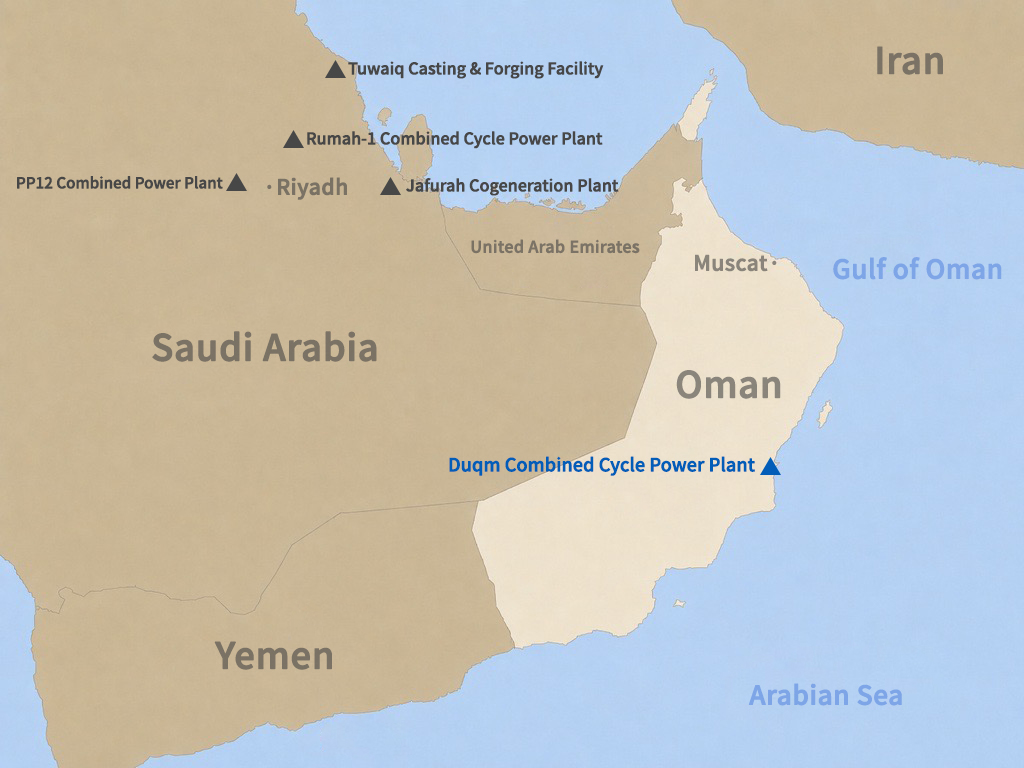
Doosan Enerbility announced on June 15th that it had signed a contract with the Korea Western Power (KOWEPO) consortium for construction of the Duqm Combined Cycle Gas Turbine (CCGT) Power Plant in Oman. The contract is valued to be approximately 530 billion won.
Doosan will be taking on the overall engineering, procurement and construction (EPC) work for the turnkey project in collaboration with its consortium partner SEPCO-3, a firm specializing in power plant construction and engineering. Moreover, Doosan will also be supplying its Doosan-made steam turbines and generators, key components of the power plant, with the target being to complete construction by 2029.
The power plant, designed to have a capacity of 870MW, will be built in the Duqm Special Economic Zone, which is located about 550km to the south of Muscat, the capital of Oman. Once it is built, the plant is expected to help meet the rising demand for electricity in the Southern Oman region and will contribute to securing a stable supply of electricity.
The client who commissioned the project is the consortium consisting of Korea Western Power (KOWEPO), Qatar’s Nebras Power, United Arab Emirates’ EUDC (Emirates Utilities Development Company)* and Oman’s Bahwan Infrastructure Services (BIS). Doosan Enerbility will be leveraging its EPC expertise and experience as a power plant components supplier to effectively carry out this project.
* Etihad Water and Electricity (EtihadWE) subsidiary, which specializes in development and investment initiatives for infrastructure projects.
“We were able to win this project owing to our extensive project delivery experience acquired over the years in the Middle East region and our EPC capabilities,” said Hyeonho Lee, CEO of Doosan Enerbility’s Plant EPC Business Group. “As we expect to see a continuous demand for newly built power plants in the Middle East region, including Oman, as part of the efforts to secure a stable electricity supply, we aim to carry out this project successfully to secure more business opportunities in the future.”